What is Monsooned Malabar coffee?
5 min read
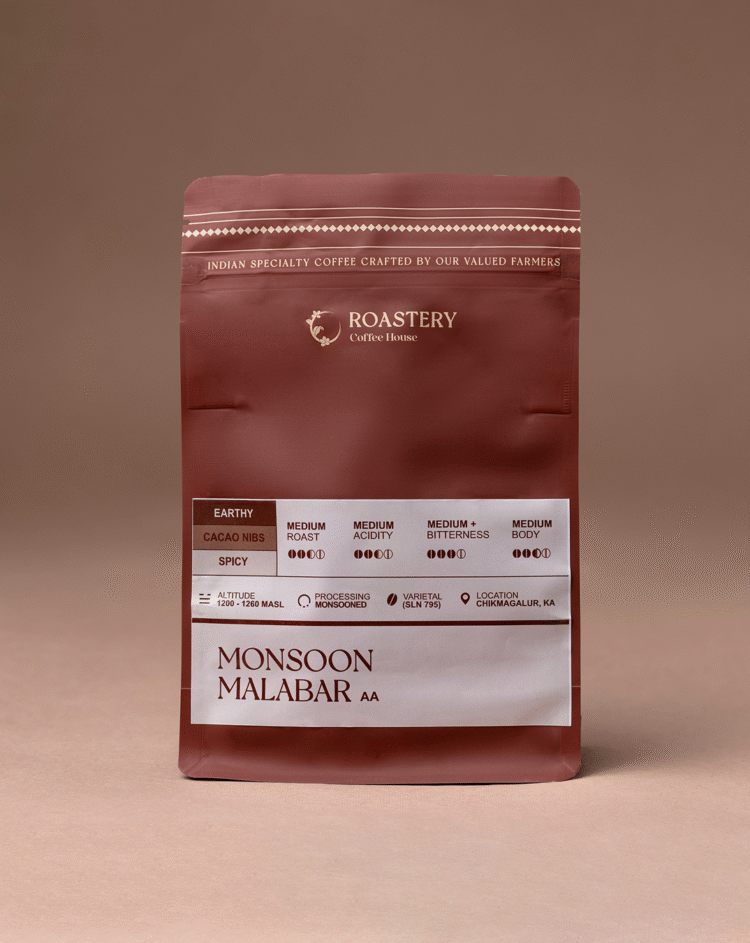
Monsooned Malabar is dry-processed Indian coffee that is spread out in open-sided warehouses on the west coast and exposed to humid monsoon winds for several months. The beans swell, turn pale gold and lose most of their acidity. The cup is heavy, mellow, earthy and spicy, and it carries a GI tag granted in 2008.
An accident turned into a craft
In the days of sailing ships, Indian coffee took months to reach Europe. Damp sea air soaked into the beans on the way, and Europeans came to love the mellow, heavy coffee that arrived. When faster ships and the Suez Canal shortened the trip, the coffee arrived fresher and buyers missed the old taste. Producers on the Malabar coast began recreating the voyage on land.
How it is made
- Arabica or robusta cherries are dried as naturals and hulled.
- During the southwest monsoon, the green beans are spread in thick layers in open-sided coastal warehouses.
- Workers rake and turn the beans so moist wind reaches them evenly.
- Over several weeks the beans absorb moisture, swell and fade from green to pale gold.
- The beans are sorted carefully, bagged and sold.
| Regular natural arabica | Monsooned Malabar | |
|---|---|---|
| Bean colour (green) | Blue-green | Pale straw or gold |
| Acidity | Medium | Very low |
| Body | Medium | Heavy, syrupy |
| Flavour | Fruit, chocolate | Earth, spice, wood, dark cocoa |
Compare: Monsooned Malabar vs Natural →
How to brew it
- Excellent in espresso, where the low acidity and big body shine.
- Great in a moka pot or French press.
- Makes a smooth, strong cold brew.
- Brilliant in milk: a cappuccino made with it tastes like dark chocolate.
Tip: Monsooned beans are large and porous and roast unevenly if you treat them like normal beans. Buy from roasters who handle them often, and grind a little finer than usual for espresso.
Monsooned coffees in stock
See all →


Questions
Is Monsooned Malabar a region?
No. It is a process. The name comes from the Malabar coast where the beans are monsooned, though the coffee can be grown in several Indian regions.
Is it good for people who dislike acidic coffee?
Yes. It is one of the lowest-acid coffees you can buy.
Is there monsooned robusta too?
Yes. Both monsooned arabica and monsooned robusta are made and protected under the GI.
Is it a light roast coffee?
Rarely. It is usually roasted medium to dark to bring out its body and spice.
Read next
Which Indian coffees have GI tags?
Geographical indications protect the names of seven Indian coffees. What they are and what a GI does and doesn't mean.
How does processing change the flavour of coffee?
Washed, natural, honey, anaerobic, monsooned. What each method does to the bean and what it tastes like in the cup.
Can you make good espresso at home in India?
Yes, with realistic expectations. The grinder matters more than the machine, and the basket in your portafilter decides how much the grinder matters.
A short history of Indian coffee
From seven smuggled seeds to a wave of specialty roasters: the milestones that shaped coffee in India.