Does altitude change how coffee tastes?
5 min read
Yes. Coffee grown higher ripens more slowly in cooler air, which builds denser beans with more sugar and brighter acidity. In India, the best arabicas usually come from the higher slopes of the Western and Eastern Ghats, while robusta grows lower down. Shade, rainfall and processing matter too, so altitude is a guide, not a guarantee.
Cool nights, slow cherries
Higher up, days are milder and nights are cooler. Cherries take longer to ripen, and the seed has more time to build sugars and acids. That gives a denser bean and a livelier, more complex cup.
Altitude in Indian terms
India sits further from the equator than many coffee countries, so coffee here grows well at lower elevations than in, say, Ethiopia or Colombia. Much Indian arabica grows at roughly 1,000 to 1,500 metres, with a few high estates in places like Baba Budangiri and the Nilgiris going higher. Robusta is mostly grown lower, often below 1,000 metres.
| Band | Typical Indian crop | Typical cup |
|---|---|---|
| Lower slopes | Robusta, some arabica | Heavy body, low acidity, cocoa, nuts |
| Middle slopes | Most Indian arabica | Balanced, chocolate, caramel, gentle fruit |
| Higher slopes | Top arabica lots | Brighter acidity, floral and fruit notes, more clarity |
Shade does some of altitude's work
Nearly all Indian coffee grows under a canopy of shade trees, often with pepper vines and cardamom beneath. Shade keeps the coffee cooler and slows ripening, which is one reason Indian coffee can taste sweet and complex even at moderate heights.
- Altitude on a label is usually a range for the estate, not a single plot.
- A well-processed mid-altitude coffee beats a careless high-grown one.
- Higher-grown beans are denser and suit lighter roasts that keep their acidity.
Tip: Dense, high-grown beans can taste sour if under-extracted. Brew them a little hotter and finer than a low-grown coffee.
| Region | Coffees | Typical (median) | Middle half |
|---|---|---|---|
| Wayanad | 7 | ₹192 | ₹170–₹250 |
| Biligiriranga Hills | 14 | ₹244 | ₹200–₹308 |
| Baba Budangiri | 84 | ₹250 | ₹160–₹380 |
| Chikmagalur | 316 | ₹280 | ₹210–₹360 |
| Coorg | 49 | ₹288 | ₹220–₹358 |
| Koraput | 41 | ₹300 | ₹280–₹347 |
| Northeast | 19 | ₹320 | ₹224–₹400 |
| Sakleshpur | 33 | ₹320 | ₹240–₹480 |
| Araku Valley | 14 | ₹321 | ₹268–₹376 |
| Shevaroys | 17 | ₹344 | ₹264–₹380 |
| Pulney Hills | 13 | ₹400 | ₹339–₹500 |
Price per 100 g of beans or ground coffee, from 1,283 listings in the live catalog.
High-grown picks
See all →

Tat Tvam Asi Organic Farm – Yellow Honey Sun-dried Arabica

Anaerobic Arabica Naturals
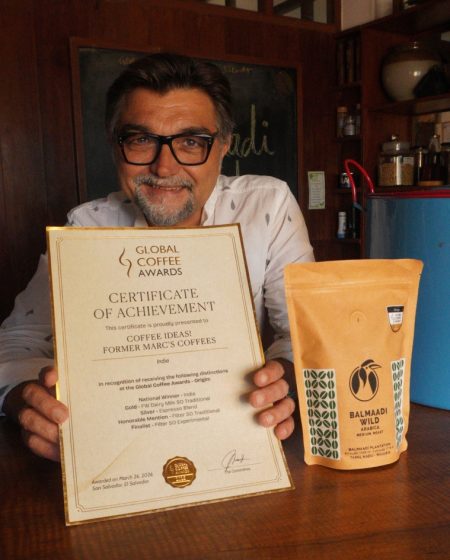
Balmaadi Wild
Questions
Is higher always better?
No. Altitude raises the ceiling, but picking, processing and roasting decide whether a coffee reaches it.
Why is robusta grown lower?
Robusta prefers warmer conditions and handles heat and pests better, while arabica struggles at low, hot elevations.
Do roasters list altitude?
Many do, usually as a range in metres above sea level for the estate.
Read next
Where is coffee grown in India?
A map in words: the southern hills that grow most of India's coffee, plus the newer regions in the east and northeast.
Baba Budangiri: where Indian coffee began
The hills where, legend says, the first coffee seeds in India were planted. What grows there now.
Which coffee varieties are grown in India?
Kent, S795, Sln 9, Chandragiri and more. The plants behind Indian coffee and what each brings to the cup.
How do you brew light roasts well?
Light roasts are dense and slow to give up flavour. Hotter water, a finer grind and a little patience turn sour cups into sweet, bright ones.